ADA Handles
Custom wallet addresses secured on Cardano.
Co-founded with my second-eldest son in 2021. I run platform engineering and the AI ops layer.
- 265K+address-resolution NFTs
- 70K+wallets resolved
- 10KNFT collection with updateable mint/edit
- Allmajor Cardano wallets adopted
The platform is a constellation of services across the github.com/koralabs namespace. The work in impact terms:
- Converted to completely decentralized minting. Anyone can mint or edit a handle on-chain within the contract’s rules. Every major Cardano wallet adopted the new policy.
- Contracts that upgrade in place. The “withdraw 0” / observer trick. Cardano lets you replace a contract’s logic without moving the locked UTxOs anywhere new, if you set it up right. We worked out the technique against live state. It’s the reason our cutover doesn’t need a state migration or chain downtime.
- NFT-based OAuth where the identity is your handle. Hold the NFT, sign in to anything that speaks OAuth. Web2 SSO ergonomics on a self-custody wallet, no custodian holding your keys.
- Merkle Patricia Tries inside on-chain code. Ported the structure into Aiken so contracts can prove membership in a dataset that’s far too big to store on chain.
- Browserless dynamic SVG rendering at scale. Every handle’s NFT image is typographic SVG generated server-side. Hundreds of thousands of unique renders across reissues and personalization.
- Serverless Cardano Node on AWS Fargate. We ran the node, Ogmios, and the Handles API on Fargate plus EFS, picking up redundancy, failover, auto-scaling, and reproducible deployment. The trick that made it work: cross-host node-socket connectivity, solved with
socat bridging a Unix domain socket to TCP.
- On-chain IPFS content validation. A Cardano smart contract validates the contents of an IPFS file by matching the CIDv1 embedded hash against bytes supplied in the redeemer. Around the 1KB to 12KB sweet spot for content size. Used live for personalization.
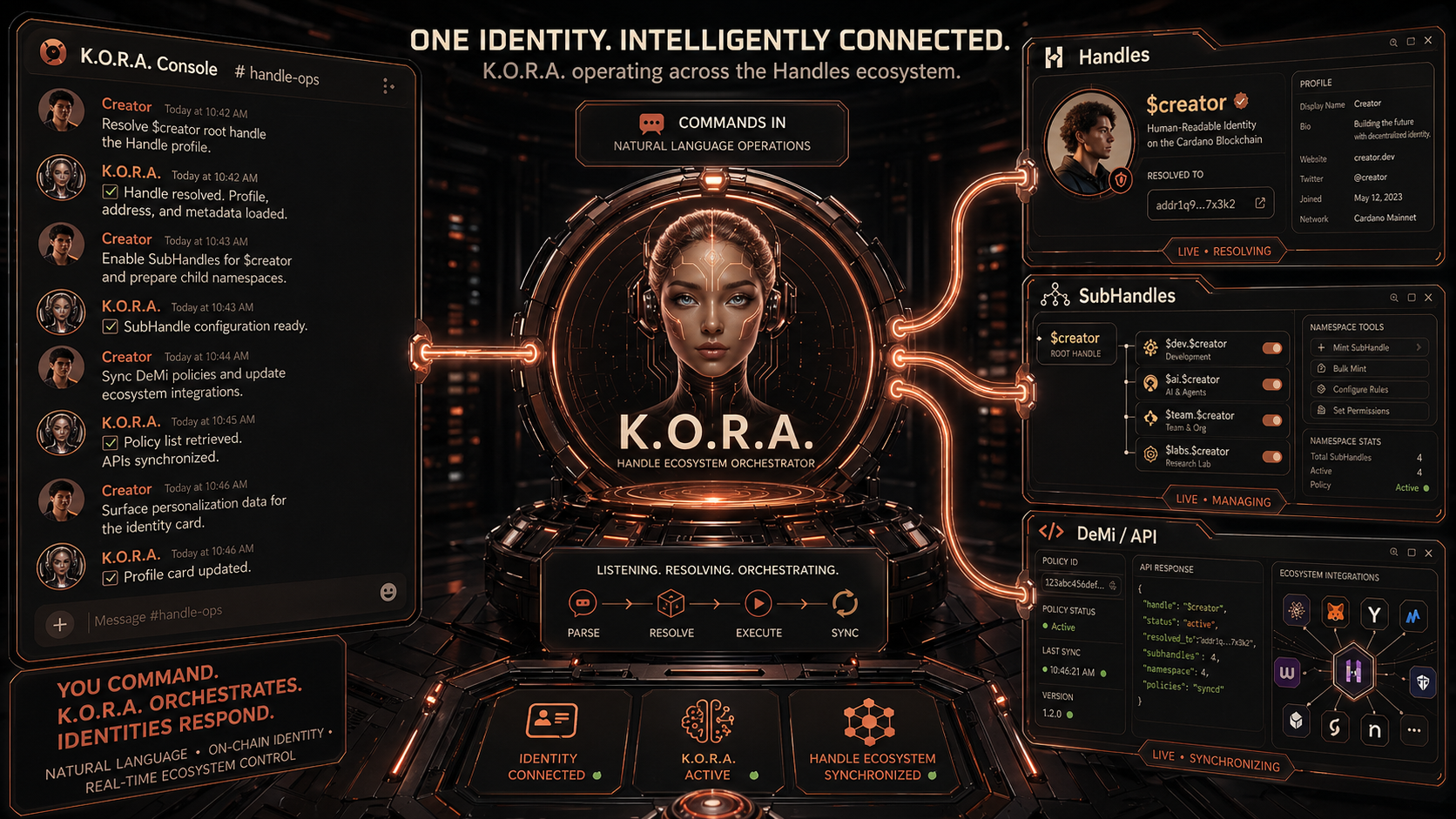
- Discord as a production control plane. Tickets land there. Deploys go through there. Alerts wake people up there. I built the bot, the CloudWatch alerting pipeline, and the deploy automation that operators trigger from chat threads. The autonomous-agent layer on top of all this is K.O.R.A.
- Two parallel cutovers - contract language and transaction tooling Smart contracts moving to Aiken: DeMi and SubHandles are there, Personalization next. The TX-building library moved to
@cardano-sdk/*.
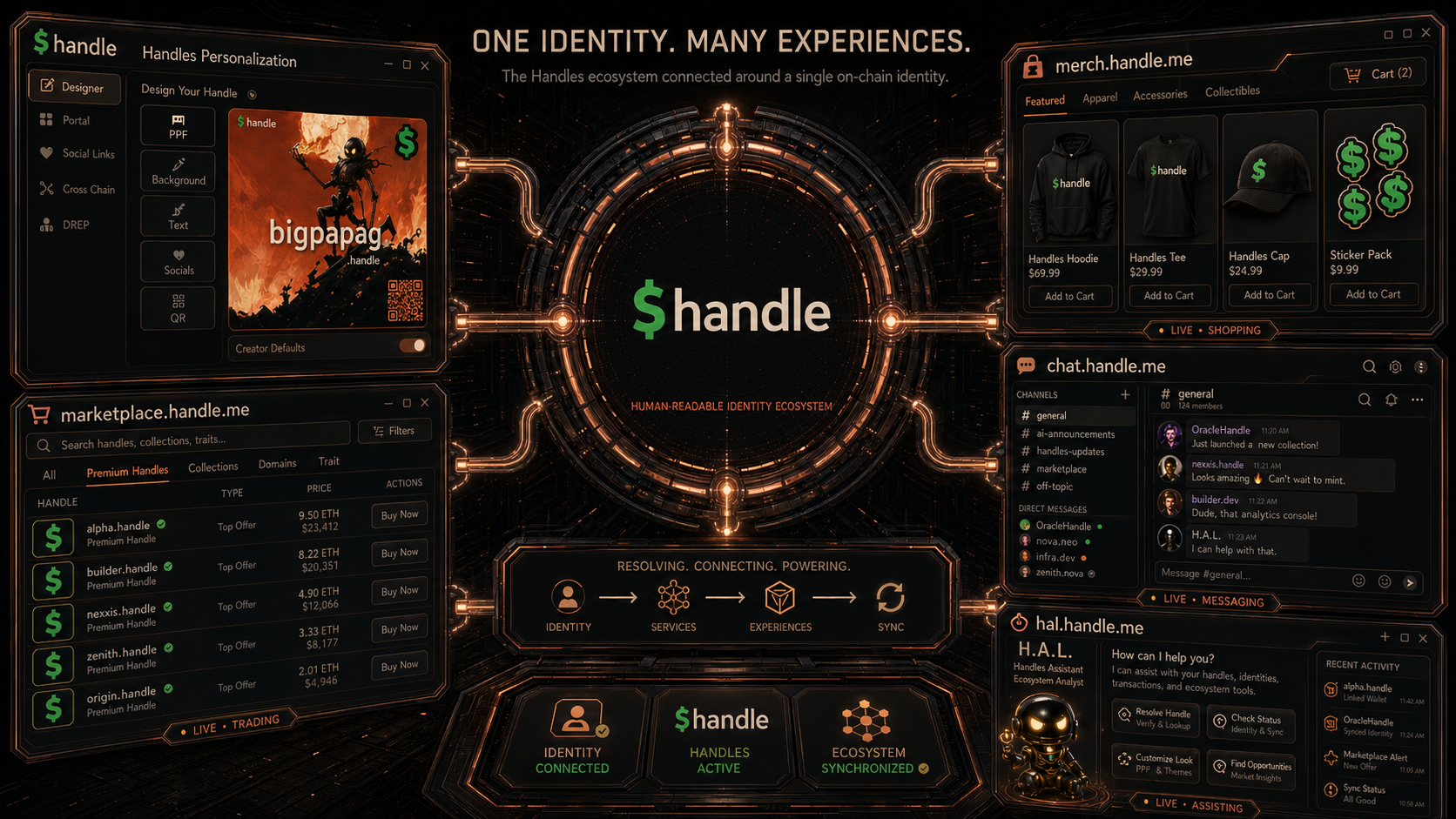
- marketplace.handle.me handles secondary trading on-chain.
- chat.handle.me runs direct messaging keyed to handle identity.
- secrets.handle.me is research-stage, looking at account recovery via social trust graphs.
- merch.handle.me and metaverse.handle.me are announced and in flight.
H.A.L. - Handle Augmented Lifeform
One of the best minting experiences on Cardano.
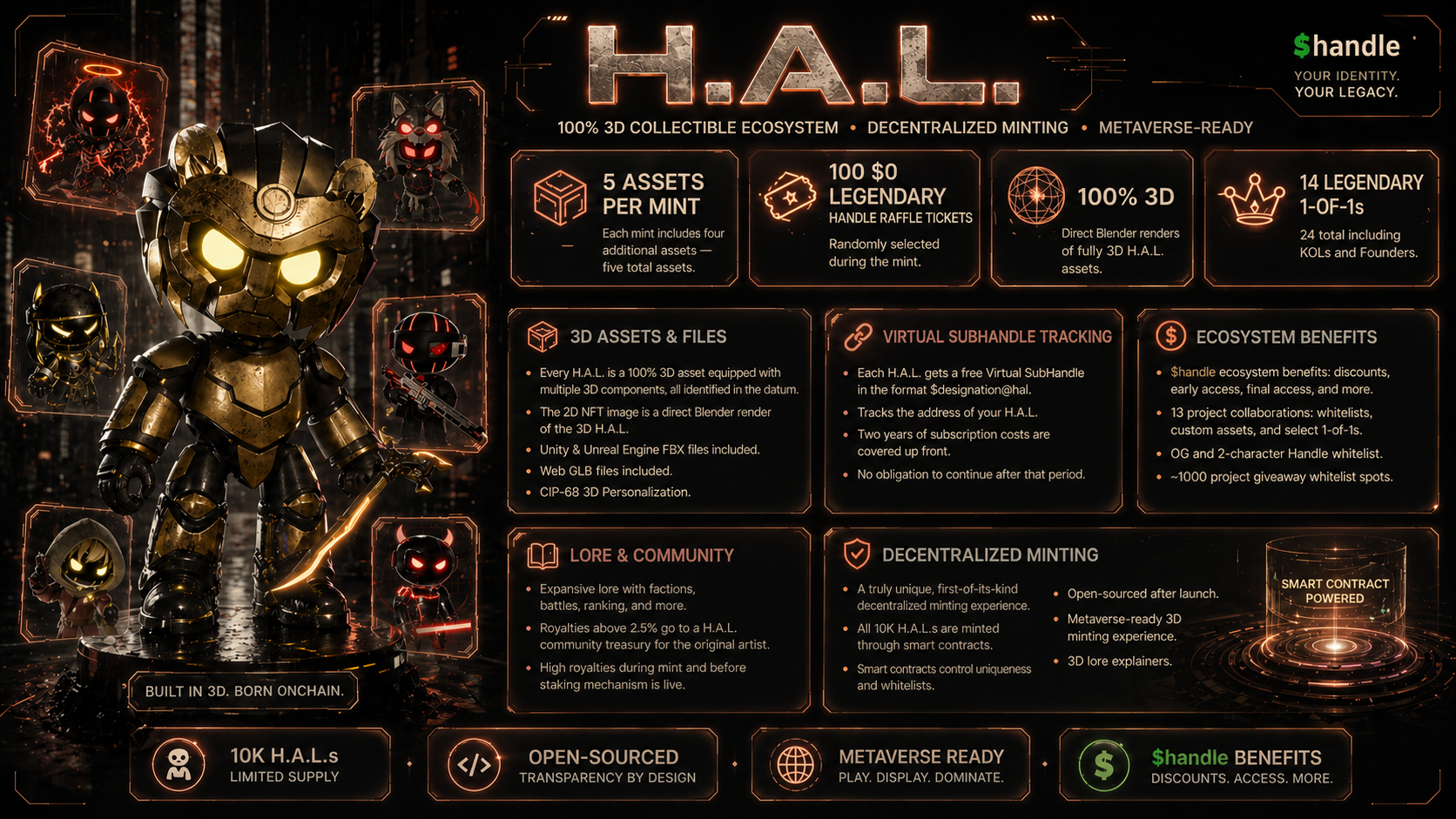
A second product line, built on the on-chain primitives Handles introduced. We expose it as an SDK, a minting engine, and 3D-asset support, so other Cardano teams can ship NFT collections without rebuilding the contracts and orchestration we already worked through.
- ~4Ktransactions chained in a single run
- 70K+tokens minted
- 8+scripts and ref inputs per tx
- 100%deterministic settlement
- 5 ASSETS! - each H.A.L. mint comes with four additional assets (five total assets per mint)
- 100 $0 LEGENDARY Handle raffle tickets - randomly selected during the mint
- 100% 3D - each H.A.L. is a 100% 3D asset, equipped with multiple 3D assets, all identified in the datum. The 2D image is a direct Blender render of the 3D H.A.L.
- FOURTEEN 1-OF-1s - 14 available legendary 1-of-1s (24 total including KOLs and Founders)
- Virtual SubHandle Tracking!
- Each H.A.L. gets a free Virtual SubHandle in the format of $designation@hal that tracks the address of your H.A.L.
- Two years of Virtual SubHandle subscription costs are covered up-front, after which there is no obligation to continue to use it.
- Unity & Unreal Engine FBX Files and Web GLB files
- $handle ecosystem benefits (discounts, early/final access, etc)
- CIP-68 3D Personalization
- 13 project collaboration (whitelists, custom assets, and a few 1-of-1s)
- OG and 2-character Handle whitelist, and ~1000 project giveaway whitelist spots.
- Expansive lore with factions, battles, ranking, etc
- Royalties greater than 2.5% (for the original artist) go to a H.A.L. community treasury. High royalties during mint and before staking mechanism is live.
- A truly unique, first of it’s kind, DECENTRALIZED MINTING experience. All 10K H.A.L.s are minted through smart contracts that also control uniqueness and whitelists. All to be OPEN-SOURCED after launch.
K.O.R.A.
Knowledge and Operations Response Assistant
- 13executor job types
- 10self-monitored heartbeats
- 30monitored repositories
- 16monitored Discord channels
A multi-component, autonomous, self-repair agent running day-to-day ops for the Handles ecosystem interfacing via Discord.
She triages tickets, moderates, monitors, responds to alerts, orchestrates deployments, and synthesizes knowledge from the ecosystem history.
The pipeline is a chat gate into an AI provider into an executor into a worker.
She tests herself in three layers: hermetic with mocks, real-process against test services, live-canary on real data with no side effects.
Nothing ships green-by-inference.
She uses Discord as the operator UI on purpose. Pinned messages contain the agent’s current settings.
Operators can use plain language to flip toggles (“turn chat responses off”) or turn knobs (“increase GIF responses to 40%”).
Alerts post to operator channels with enough metadata for K.O.R.A. to triage them. When someone types “deploy to mainnet” or “troubleshoot this ticket,”
K.O.R.A. actually does the deploy or looks into the ticket.